Your Retirement Money May Not Last as Long as You Think
Most people open an IRA because someone told them it was the smart, responsible thing to do. Contribute a little each year, get a tax break, watch it grow, and use it in retirement. Simple, right?
Not quite. Traditional IRAs come with rules, deadlines, and tax traps that can catch you off guard at the worst possible moment. If you’re not careful, you could hand a much bigger slice of your savings to the IRS than you expected.
Here are six common IRA mistakes worth understanding, so you can protect the money you have worked so hard to build — and help ensure the money you’re setting aside for retirement can last as long as possible.
1. Forgetting That an IRA Is a Tax Bill Waiting to Happen
When you put money into a traditional IRA, you get a tax deduction today. That feels great in the moment. But the government does not waive those taxes. They’re just postponed.
Every dollar you eventually pull out of that account, including all the growth, is taxed as ordinary income. So your IRA balance is not really “yours” in full. A portion of it belongs to the IRS, and the final tax bill depends on future tax rates, which nobody can predict (and which many assume will likely be higher).
What’s more, many people wrongly assume they will be in a lower tax bracket in retirement. The problem is, this is often not true. By the time you retire, you’ve typically lost the deductions that once reduced your taxes, like dependents (because your kids are grown), mortgage interest (because your home is paid off), and business expenses (because you’ve retired).
In addition to that, if tax rates rise, or if you have Social Security, pensions, and required minimum distributions (RMDs) all hitting at once, you could easily land in a bracket that’s as high or higher than during your working years.
The lesson: Do not treat your IRA statement as the full picture of your wealth. Think of it in after-tax terms, and plan accordingly.
If you forget to take your required minimum distributions (RMDs), or you take out less than required, the penalty can be steep. Even after recent reductions in the penalty rate, missing an RMD can still cost you thousands of dollars, on top of the regular income tax you owe.
The mistake many retirees make is assuming they can leave the account alone as long as they want. You cannot. Once RMDs kick in, the IRS has essentially opened up its own piggy bank to collect taxes on your withdrawals.
3. Naming the Wrong Beneficiary, or None at All
Your IRA does not pass through your will. It goes to whomever is listed as the beneficiary on the account itself. It’s important to keep your listed beneficiary updated, as an outdated form can send your retirement savings to an ex-spouse, an estranged relative, or straight into a messy probate process.
Keep in mind that under current rules, most non-spouse heirs must empty an inherited IRA and pay taxes on those withdrawals within 10 years…or face serious penalties. These withdrawals can push your beneficiaries into a much higher tax bracket during their peak earning years, so make sure everyone is aware.
And if you were taking RMDs at the time of your passing, your beneficiaries must also continue those RMDs, regardless of their age.
A quick review of your beneficiary designations, especially after a marriage, divorce, birth, or death in the family, is one of the simplest and most important things you can do.
4. Rolling Over the Wrong Way
If you want to move IRA money from one institution to another, how you do it matters.
A direct transfer, where the money moves from one custodian straight to another, is generally clean and non-taxable. But if the check from closing out your current IRA is made out to you personally, the clock starts ticking.
You have 60 days to redeposit the full amount into another qualified account, or the IRS may treat it as a taxable distribution. If you are under 59½, you could also face a 10% early withdrawal penalty.
People lose thousands every year simply because a rollover was handled the wrong way. When in doubt, ask for a direct trustee-to-trustee transfer.
5. Overlooking Ways to Move Your Money From IRA to Other Vehicles
Many people don’t realize they can move money from their IRAs to financial vehicles that can provide even more benefits.
Take for example, a Roth conversion.
With a Roth conversion, you move money from a traditional IRA into a Roth IRA and pay the tax on that amount in the year you convert.
Why move money to a Roth IRA? Roth IRAs work the opposite way from a traditional IRA.
You pay taxes now, and when you go to access qualified withdrawals in retirement, you can do so tax-free. There are also no lifetime RMDs on a Roth IRA for the original owner.
Paying those taxes sooner than later might sound painful, but when timed right, it can be a smart move. Think of making conversions in years when you have room left in your current tax bracket, before Social Security income starts, or during a period when tax rates are historically low.
You do not have to convert everything at once. Many people convert small amounts over several years to spread out the tax hit.
Instead of a Roth conversion, many of our clients opt instead for what we call a strategic rollout from an IRA to a properly structured, maximum-funded Indexed Universal Life (what we call an IUL LASER Fund).
Over about five years, they essentially get the taxes over and done with at current rates, repositioning money from their IRAs into IUL, where they can enjoy:
Tax-free growth
Protection from losses due to market downturns
Access to tax-free income via policy loans, while the cash value can still earn returns
Income-tax-free transfer of wealth to heirs that avoids probate
The biggest mistake is doing nothing and letting your traditional IRA grow into a bigger and bigger tax liability. This is where guidance from a qualified tax professional and/or IUL specialist can really pay off, because a lot depends on your personal situation.
6. Assuming Your IRA Is the Only Retirement Tool You Need
Never fall into the trap of believing that an IRA, by itself, is a complete retirement plan.
An IRA can be helpful, but it has its drawbacks. For starters, you’ve got contribution limits: currently $7,500 a year ($8,600 a year if you’re age 50 or older).
If you withdraw money before age 59½, not only will you pay taxes on those withdrawals, but you’ll also typically pay a 10% penalty.
You’re also at the mercy of market volatility. With an IRA, your money typically rises and falls with the market. This can be great when the market goes up. But when it drops — like it did in 2008 when millions of Americans lost 40% of their traditional account values — it can take a serious bite out of the money you’ve set aside for retirement.
A well-rounded retirement plan usually includes a mix of accounts that offer different benefits, including IUL LASER Funds. Creating a diversified approach to setting aside your serious cash and mitigating the impact of unnecessary taxes can make a real difference in your future.
Action Steps: How to Make Wise Decisions With Your IRA
Carefully weigh the upsides and downsides of IRAs to determine how big of a role IRAs will play in your retirement plan.
Avoid the 6 mistakes outlined in this article.
Consider diversifying your retirement portfolio with IUL LASER Funds to gain protection from market losses, tax-free growth, and access to tax-free income via policy loans.
Your IRA is not a bad move, but there are some limitations to consider. The people who end up with the most peace of mind in retirement are the ones who understand the rules, review their accounts regularly, plan for taxes instead of being surprised by them, and add tax-free vehicles like IUL LASER Funds to their retirement portfolio.
A little awareness today can protect a lot of income tomorrow, both for you and for the loved ones who will one day inherit what you have built.
Ready to Step Into a Brighter Future?
Start exploring more about the tax advantages and market protection of IUL today—access our free books, attend our educational webinars, or connect with a Certified Laser Fund Professional right here.
*Retirement account and policy performance and/or experiences are shared for educational use only and do not predict or guarantee actual or future results.
_______________________
Watch Doug Andrew explain these concepts in more detail on his YouTube channel…
Six Withdrawal Mistakes at retirement planning is something totally different than what you may have done for your retirement planning. IAS and 401ks are a tax trap. And most Americans end up paying back 12 to 15 times the taxes they saved on owning [music] IRA and 401ks during their retirement. In this educational video, I’m going to reveal the six mistakes that Americans retirees make when they take money out of their IAS and 401ks. I’m also going to teach you about an incredible strategy called a strategic roll out, not a roll over. Okay? Uh a rollover is um going from the frying pan to the fire as you will see. Don’t continue to uh postpone, defer, procrastinate paying tax to some future perceived unknown advantage and then making the mistake of taking RMDs, required minimum distributions, which is the worst advice for most retirees. You’ll see why. I’ll show you examples of how we’ve saved retirees from 250,000 in unnecessary tax up to 1.2 million. Get ready. Uh you will miss out if you don’t learn this. [music] So folks, uh I’ve discovered as I meet with people as a retirement planning specialist that uh most Americans draw income during their golden years from uh one uh two, three, or maybe all four of these different general resources. Okay? uh investment income, real estate income, guaranteed income, but here’s the most underutilized and my favorite, the tax-free income. Okay. Now, there are six big mistakes most Americans make when uh getting money out of their IAS and 401ks or or qualified accounts. Okay. So, let’s let’s go through these so that you can understand where I’m coming from. Uh the first mistake people make is postponing taking money out uh beginning at age 59 and a half. If they Tax Bracket Strategy don’t need the money, they think, well, let’s just keep deferring. I have to pay tax. Uh, and they keep deferring and postponing procrastinating until they’re 70s and and then they uh think they’re saving tax by taking the minimum amount out or an RMD. I’ll get to that one. Okay. The second big mistake is uh only taking the minimum needed even if uh they are in that stage where they have to take the required minimum thinking you’re saving tax rather than taking advantage of all the room before the next tax threshold. Okay, I’m talking about tax brackets here. So, if you’re a little cloudy already, let me give you an example here. Uh I’m going to use uh uh the tax uh brackets for the year 2026. Uh these just go up a little bit every single year. The concept is the same. So, for example, a single person in America filing an individual tax return uh with a 2026 taxable income, let’s say over 50,000, that’s after deductions and exemptions, uh up to 105,000. That’s 55,000 of room. Okay. What do you mean room? Well, that that’s how much between 50,000 up to 105,000 of income, you are in the same tax bracket, 22%. Okay, that’s room that if you don’t use it, you’ll lose it forever. Uh, if you’re a single taxpayer between 105,000 up to 201,000, that’s 96,000 of room that you uh if you don’t pay tax at 24%, you’ll likely never be in that low of a bracket again. Okay, let’s go to a married couple filing a joint tax return. Same tax year in 2026. a married couple filing a joint tax return. Your taxable income again that’s your after deductions and exemptions between 100,000 and 211,000 that’s 110,000 of whom you only pay 22% in federal tax. Okay? Plus the state taxes 41 out of 50 states as as a state income tax. Between 211,000 up to 403,000 that’s 192,000 of room that you would only pay 24%. because if you don’t use that room, you will lose it. And that was set to jump from 24% up to 28% at the uh at the end of 20 25. And uh but I think it’s going to jump back up to there sometime, probably sooner than later. Okay. Uh and so when this um tax act that Donald Trump passed clear back in 2017 uh ends up changing or expiring or whatever and will likely expire or uh at the end of his second term, which has of course not happened as of the recording of this episode. So let me give you an example of this. What what will happen when it does end? The 12% tax bracket moves up to 15. The 22 moves up to 25. Okay, that’s not just 3% more. It’s 13.6% 6% more [music] money. I’ll explain that here in just a second. The 24% bracket, many Americans are in a 24% tax bracket. That will go up to 28%. That’s 16.66% more. People go, “What?” Okay. Now, the 32 goes up to 33, but the 37 goes up to 39. Here’s the biggest impact. The 24% bracket jumping to 28. Now, why is that 16% more, folks? on every thousand dollars of taxable income. [music] If you pay 24% in tax, you’re going to pay 240 bucks. If you go up to 28%, you’re going to pay 28 uh 280 bucks, right? [music] Uh that’s $40 more. What percent of of $240 is $40? Okay, that’s 16.66% more money. It will be the biggest tax increase Americans will ever ever see. And if you don’t use this room, you will lose it. Okay, so let’s finish out these mistakes. The third mistake is Reinvesting After Taxes repositioning any money you do take out and pay tax on into something that’s taxable, putting it in a bank or a mutual fund. Stupid? No, you reposition that in something tax-free. Number four, not having a withdrawal strategy based on your optimal tax bracket each year. That’s what I’ve done as a as a tax planning specialist for years. Uh, and so if you don’t, you’re going to kick yourself and if you don’t use that room, you’ll lose it. And so you got to have a strategy. Number five, people that take RMDs, required minimum distributions, or they use what is called the 4% rule. That’s a huge mistake, and I’m going to prove it to you. Uh, the sixth mistake is leaving behind money in IRA or 401ks to your non-spousal heirs, your your kids and your grandkids. Uh most uh CPAs and tax attorneys uh that I teach uh they end up going, “Oh my heavens, the worst place to leave money when you die is in an IRA or 401k to your kids.” Why? The kids can’t keep deferring it until they retire. They have to pay tax within 10 years on that under current tax law. It’s the worst place to leave money. Okay. So, uh what should you be doing? Let me ask you this question. This is a very popular YouTube video on this channel. is your retirement estate too topheavy and yet to be taxed IAS or 401ks. So let’s go back to this Four Income Buckets particular uh illustration I started with. But uh let me go deeper into what they are. The purple category or the purple bucket is where unfortunately 91% of Americans are way too topheavy in this purple bucket with money in yet to be taxed IRA and 401ks invested where in the market the volatile market. Wall Street was never designed to create predictable income, folks. And that’s why they came out with the 4% rule. But a lot of people have their money trapped in this purple bucket and now they they have to pay tax. And they didn’t realize it. They were always told just max out your IR 401k. You’ll likely be in a lower bracket when you get there. Most savers in America are not in a lower bracket when they retire. And they’ve been killing their deductions along the way. Okay. Now, some people own real estate. I own real estate, but uh uh real estate is not the cat’s meow. And a lot of people [music] actually get sick and tired of being a landlord as they approach retirement, you know, taking out the trash and fixing toilets and evicting tenants and all that. And but [music] they’re stuck because they don’t want to pay a capital gain tax and they’ve been doing 1031 exchanges and so forth. Folks, uh capital gain taxes uh may likely double from 20% up to ordinary income rates uh close to 40%. And uh you know, congressional revenueers have even talked about uh taxing unrealized capital gains and doing away with the step up in basis when you die so that your kids inherit those those properties and uh they don’t have to pay the capital gain tax. They may do away with all of that because when you are running a deficit, tax revenueers always look for ways to get money from you when you do transactions. Okay? Now, uh, I’ve [clears throat] helped many people who want to keep their real estate do much better, as I’m going to show you here. I’ve also helped people, uh, determine when it’s wise just to sell, pay the capital gain, and put the net into it. And I have many videos on this channel that show that, but uh, don’t be relying on your real estate having tenants in there. I can show you how to have income out of your real estate, even if they are vacant, even if you have no tenants. Okay? Most adviserss never teach you why or even how to do that. Uh the orange bucket I call the guaranteed bucket. This would be like social security income or pensions or an annuity. This is for people that are very conservative uh and uh they’re not so concerned about being rich. They just don’t want to be poor. So they don’t want to outlive money even if that money becomes worth less and less because of inflation. And so that’s the orange bucket. Uh my favorite is the green bucket, the tax-free bucket. And that would include uh you know, Roth IAS or 401ks, but if you’ve watched very many of my episodes on this channel, uh you quickly learn that I’ve never owned an IRA or 401k or a Roth IRA or 401k and never will because my favorite vehicle, a properly structured maxf funed IL laser fund, uh has six major advantages. Uh Roths only have two of those six. And uh and uh the AIA laser funds have been around in the Internal Revenue Code for over 120 years. Roths have only been around since 1997. Ross have too many strings attached. You can only put in a certain dollar amount or certain percent of your income. Uh you have to leave the money there for five years or wait till you’re 59 and a half to access any of the gain. Uh and they don’t blossom when you die. They’re subject to market volatility most of the time. I don’t want any of that. Okay? And so why would I mess around with a Roth when I have all all the the the benefits of a Wroth and and four additional huge benefits that Roths will never have? So mine’s a maxf funed tax advantage insurance contract. Now there are municipal bonds here. Most people realize municipalities are filing bankruptcy these days and they’re low yielding and so they’re not attractive anymore. So my favorite vehicle is is the maxf funed tax advantage uh IL laser fund called. Why? Well, what I’m about Strategic Rollout Explained to show you is a strategic roll out. This is not a rollover. A rollover would be taking money in in a 401k, rolling over to an IRA, deferring, pro postponing, procrastinating till you’re age 72, 73, and then and then taking RMDs, thinking you’re saving tax. I can prove you’re not saving tax. You’re increasing the tax big time. And I’ll give you some examples here. No, you want money rolled out, but you don’t roll it out and pay tax and put it into a taxable investment. uh you roll it out and put it into something tax-free from now on. And if you choose this one, my favorite, it will actually reimburse you for all the tax you paid when you rolled the money out. Okay? So, I would recommend at retirement. Okay? No more than 30% of your retirement income should be coming out of that purple bucket. And many clients say, “I don’t want any any money in that bucket. I want I want all my income [music] to be taxfree.” See, I recommend that 40 to 60% of your retirement income uh not even show up on the front page of your 1040 tax return. Okay? The IRS will know you’re receiving it. They they know everything, but it’s taxfree. Okay? Uh and so some people say, “I want 100%.” So, they get it all out of there. Uh real estate, I recommend no more than 30% of your retirement income be relying on you having tenants in your real estate. And I’ll show you how you can be making uh a lot of money on your real estate, even if it’s vacant. you have no tenants. Okay. Uh between 0 to 80% uh could be in the orange bucket based on your risk tolerance. But again, I recommend 40 to 60% of your retirement income come out of this green bucket tax-free. Okay. So, in a nutshell, uh strategic rollouts are there. There’s three major steps to them and they’re independent of each other. The first uh step is to strategically reposition your retirement funds, subjecting them to tax at today’s lower rates and also while your account values are lower. Thus taking care of taxes now rather than postponing and increasing the inevitable liability. You’re not saving tax by continuing to defer. Okay? Get them over and done with. The second step is to reposition the after tax monies into investment vehicles that will allow tax-free accumulation, tax-free distribution, and then tax-free transfer. And many times you’ll be totally reimbursed for all of the tax liability uh when you ultimately pass away. Okay. Number three is sort of icing on the cake. I’m a tax strategist. I’ve helped many, many of our clients offset some or all of the tax liability incurred during a roll out by creating new deductions, maybe new charitable deductions, but mortgage interest deductions is my favorite. Uh, so they continue to earn taxfree interest for life on what you paid in tax. Okay, so let me show you how all this works. [clears throat] Again, there’s three types of income subject to tax in America ever since 1986 tax reform, President Reagan’s second term. Earned income, which is salaries and wages. passive income, which would be rental income or lease income. Portfolio income, which would be interest dividends. [music] If you have income that is not one of those three, there’s nowhere on a 1040 tax return to put it. Okay? Uh the IRS will know you’re receiving it. They know everything, but it’s not taxable. Uh income out of an IL is [music] not taxable. Now, in the book I want to gift Client Tax Results you here at the end, um, uh, there are stories in there about school teachers where I saved these school teachers a quarter of a million dollars of unnecessary tax doing a strategic roll out from their 401ks and 403bs and TSAs. Okay. I also have a story of how we saved a real estate landlord a quarter of a million in tax and we actually quadrupled his income. I’ll go into a little bit of a deeper illustration of that in a moment. uh how we had a husband and wife, both physicians, they saved 4.6 [music] million in their IAS and 401ks, and uh they were going to pay by [music] by postponing uh and then taking RMDs out to the husband’s life expectancy and the wife’s life expectancy and then passing down to their kids. At a minimum, they were going to pay 2.6 million of the 4.6 million in tax. And their adviser says, “Well, they can afford to pay 2.6.” Oh, golly. I said, “Well, let’s ask them.” I was not able to save them all all 100 100% of that 2.2 but I saved them 1.2 million. That 1.2 million they were thrilled because that money would have gone down the drain in unnecessary taxes now generating over a h 100,000 a year of tax-free [music] income or cash flow for their family, their kids and grandkids into perpetuity in what is called their family bank. I can show you how to set up your own family bank. Uh we had a couple in California. We took them from the highest tax bracket to a 0% tax bracket in five years. They now have 8 million tax-free, generating 600 to 800,000 a year of taxfree income. They don’t even really have to file a tax [music] return. How would you like to be them? Okay. But they bit the bullet and t paid over 2 million in tax during a roll out, but they came out way ahead by getting the taxes over and done with sooner than later. We had a couple in California that came to us with $2.6 $6 million accumulated in their IAS or 401ks. Uh I think based on a 6% payout, they were uh expecting about 160,000 a year of portfolio income. Okay. They had another 40,000 of guaranteed income from social security or a school teacher pension. So they were feeling pretty good. Hey, Mr. Andrew, we have uh 200,000 of income. I said, “Well, that looks good. You’re in the top 1% of Americans, but there there’s one big problem.” They said, “What what is it?” Well, it’s all showing up on the front page of your 1040 tax return. All 200,000. You’re going to pay at least 54,000 in tax. Every year, the rest of your life, you’re only netting 146,000. We did a strategic roll out for them. And uh after 5 years, they still have 200,000 of income, but 120,000 of it now is tax-free. They only have to pay tax on 80,000, which is only 21,000. They now have 178,000 net. We saved them $32,400 a year in tax. Uh it’s even more than that now. We will have saved them over $1 million of unnecessary tax by the time uh they both pass away. Okay. So, let me give you an illustration. Get Mortgage Leverage Example ready. I You probably weren’t expecting this one, but I’m going to throw it in here. Uh this is tax to the max versus Mrs. Ivalot more. So, pay close attention. This may not be for you, but here’s how we do it. Okay, these uh two individuals are both uh 59 and a half. Okay, and they’re in the same situation. They have $500,000 accumulated in their IRA and 401ks, and they each have a million-doll house that’s free and clear. Okay, they they’ve worked for several years to pay it off. So far so good. Now, here’s the difference. [clears throat] Tax to the max follows the herd. Uh Mrs. Ivot More came to me as a tax strategist. and let me show you what I did to more than double uh her situation over Tax to the Max. So, uh what Tax to the Max did, he said, “Well, I don’t need the money. I’m just 59 and a half, so why should I, uh do a roll out? Let me continue to defer.” He was earning 7.2%. Rule of 72 math. This is easy. His 500,000 doubles to a million in 10 years uh by age 70. Okay. Now, let’s say he retires and he starts taking out the interest uh 7 72,000 a year, 7.2% on a million. Uh but that’s taxable. Uh in a 33% combined federal and state tax bracket, he’s going to pay 24,000 in tax and only net $48,000 or $4,000 a month to buy gas, groceries, prescriptions, and golf green fees. Okay? Uh you can tell he probably lived in a state like California because he’s paying 33% or more in tax. Now, what does he do? Uh, both he and his friend, Mrs. Ivalot Moore, they’re selling their home and, uh, they’re going to, uh, buy two $500,000 retirement homes, one in a summer climate climate and one in a winter haven. Okay? And so, this [clears throat] is, uh, what happens. Uh, Mr. Tax to the Max uh, sells the house and has a million dollars and goes and pays cash for two $500,000 homes. he doesn’t want a a mortgage payment. 90 days goes by and he just permanently killed his ability to tax deduct interest uh on the maximum acquisition and debt. If that went over your head, that’s okay. He he just blew it. Okay. Uh so let’s compare to Mrs. I have a lot more. Uh when she sells her house for a million, she doesn’t pay cash at my advice. She goes out and she finances her two $500,000 homes at 80% loan to value. Okay. So, uh, she has two $400,000 mortgages. Okay. Now, yeah, she’s got some mortgages. I’m going to show you why that’s a good thing. Uh, she only tied up though 200,000 of the million. She She has 800,000 left over. [music] I’m going to show you what that does. 800,000 in mortgages, but she has 800,000 of cash. So, she’s really out of debt anytime she wants to be. She just takes her cash and pays off those mortgages. the mortgages, let’s say at six and a quarter% interest. Uh that’s 50,000 a year in interest. [music] Let’s say it’s an interestonly mortgage just to show you how simple this is. Now, uh so she’s got 50,000 of interest on that. Now, how’s she going to make that mortgage payment? Well, she with withdraws 50,000 a year out of her IAS or 401ks. She’s got 500,000 in there, right? She starts doing this at age 60. She pulls out 50,000 a year that is now subject to tax on the front page of her 1040 tax return. Okay. But it’s offset because she’s taken it to do what? Pay 50,000 of interest on the two retirement homes. So it offset the tax. She has 50,000 of income coming out of an IRA or 401k, but it washes away with 50,000 of interest deduction that Tax of the Max did not have. In the meantime, uh the 800,000 at 7.2% grows doubles in the same 10-year period just like tax of the max uh 500,000 did uh to 1.6 million taxfree in the IL. That 1.6 million can generate uh 144,000 a year of taxfree income with [music] just an 8% payout. How much more is 144,000 than uh tax with the max 48,000? Three times. She has three times the income. Hers is taxfree. [music] His is net after tax. Okay. Uh and so way way better off. We do this all the time. She ended up with triple the income and uh we offset all the tax of getting a half a million out of her IAS or 401ks over a 10-year [music] period taxfree. Folks, if you want to see how LASER Fund Next Steps this works in your particular set of circumstances, I would recommend [music] uh that you check it out, meet with one of my adviserss. Um but just read about it in my book. Uh this is my most recent bestselling book, uh the laser fund, how to diversify and create the foundation for a tax-free retirement. It’s two books in one. This white covered side is the uh leftrain side. Okay? [music] If you like the charts and graphs and explanations, that’s about 200 pages, 14 chapters, and and you’ll see all of the the the logistics and the logic behind it. If you’re more of a rightbrain learner or thinker, you flip it over to the orange book. That’s about 100 pages, 12 chapters with 62 actual client stories. The the stories of the school teachers and the real estate landlord are in here. Okay? Uh if if you want to use your whole brain, your right brain and your left brain, I’d recommend you read the whole book. Simply go to laserfund.com or click on the link below. Contribute a nominal amount towards the shipping and handling. I require a little skin in the game. I’ll cover the rest of that cost and I’ll pay for the book. I will fire out a hard copy to you via priority mail. But while you’re in there claiming your free copy if you like to listen and learn or watch and learn, there’s those educational formats for a nominal investment. You can schedule to attend one of our free educational webinars that we do every week. Uh you can even schedule an appointment to talk to an IL professional that can show you how this may work in your particular set of circumstances and have a strategic rollout report. No cost, no obligation. [music] But don’t miss out.
_______________________
Frequently Asked Questions (FAQs)
Q: Which vehicle allows me to access money tax-free — IRA or IUL? A: With IRAs, you’ll pay taxes on withdrawals. With IUL, you can access income tax-free via policy loans.
Q: Is there any risk of losing money due to market volatility with an IRA or IUL? A: With IRAs, your money is typically invested in the market, which means when the market drops, your IRA account value also drops. With IUL, your money is linked to the market, but not actually in the market. When the market drops, your cash value is typically protected by a 0% guaranteed floor. And when the market goes up, your cash value goes up as well, depending on the index you’re linked to.
Q: Do I have to take required withdrawals with IRAs or IULs? A: With IRAs, the government requires you to take required minimum distributions (RMDs) currently starting at age 73 and pay taxes on those withdrawals, or face serious penalties. With IULs, there are no RMDs. You can choose to leave your money in the policy, with the opportunity for it to continue growing tax-free, or you can access money tax-free via policy loans (while your cash value can still earn interest).
Q: Where can I learn more about the IUL LASER Fund or start my own policy?
A: Order our comprehensive “The LASER Fund” book for free (you just cover shipping) at laserfund.com, attend a virtual educational event, or connect with a certified expert by clicking here.
_______________________
Still have questions? Want to unlock your own tax-free retirement strategy?
Connect with an IUL LASER Fund specialist today: Get started now.

 1. Forgetting That an IRA Is a Tax Bill Waiting to Happen
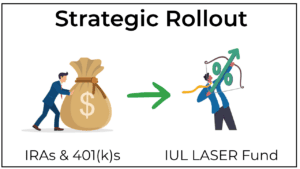 Instead of a Roth conversion, many of our clients opt instead for what we call a strategic rollout from an IRA to a properly structured, maximum-funded Indexed Universal Life (what we call an IUL LASER Fund).