
To help you optimize your properly structured, maximum-funded Indexed Universal Life policy (what we call an IUL LASER Fund), it’s important to be aware of index strategies that can help you make the most of your opportunity for growth. To do that, let’s take a closer look at a strategy many clients turn to…dollar cost averaging.
As you’re funding your IUL LASER Fund and choosing your index strategies…
Did you know it’s not just the type of index strategy you can choose (like the S&P 500 one-year point-to-point with a 10% cap or the Black Rock Endura), but also the way it’s allocated?
Understanding Allocations
Typically, index strategies are tied to the month the premium is originally paid.
For example, let’s say you pay $120,000 into your IUL LASER Fund in April 2026 and you choose the S&P 500 one-year point-to-point with a 10% cap. By default, that entire $120,000 will be tied to an April-to-April maturity period.
So if we fast forward to April 2027, let’s say the S&P 500 is up 12.5%. With the cap, you would be credited 10% on that $120,000, or $12,000.
Now is April necessarily going to be the best month of performance for the S&P 500?
Since no one has a crystal ball, we don’t know.
And this is where dollar cost averaging can be appealing, because dollar cost averaging allows you to spread out returns over the coming year, essentially tying a portion of your premium to all 12 months.
 The Advantage of Dollar Cost Averaging
Let’s say you had chosen the S&P 500 one-year point-to-point with a 10% cap, but this time with dollar cost averaging.
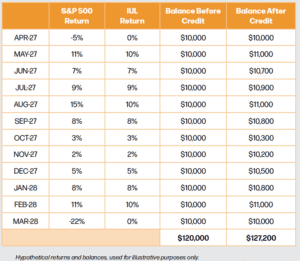
Now $10,000 will be tied to the S&P 500’s performance from April to April. Another $10,000 will be tied to May to May, and so on, through March.
So let’s imagine instead that from April 2026 to April 2027, the S&P 500 drops 5%. May 2026 to May 2027, the S&P 500 rebounds at 11%. June 2026 to June 2027, it increases 7%.
In this scenario, in April 2027, you would have been relieved to know that only $10,000 is tied to that drop, and your cash value is protected with a 0% floor. In May, you would earn up to the 10% cap on the next $10,000, and so on, with each month’s performance being credited to your policy.
This way, dollar cost averaging keeps you diversified throughout the year, smoothing out the earning potential and creating greater flexibility, which can help if the market experiences large shifts.
All Your Eggs in One Basket?
Now do we recommend dollar cost averaging for 100% of your premiums? Not necessarily.
Overall, we are proponents of using a diversified approach to your index strategies. You might want to choose dollar cost averaging for a portion of your premiums, and stick with lump sum premiums for another portion.
You might also wonder — what if you’ve already maximum funded your policy and you had previously chosen lump sum strategies? Can you switch to dollar cost averaging?
The long answer is yes, but it will require you to move your cash value from your current strategy to the fixed General Account Portfolio first. After that, you can move 1/12 of the amount at a time into a dollar cost averaging strategy.
Another question that comes up — is dollar cost averaging always going to be better than lump sum premiums?
Given that IUL is a long-term strategy, with most policyholders owning them for more than 30 years, both approaches tend to fare similarly over the long haul.
That said, many policyholders like the ability to smooth out their returns year-over-year with at least a portion of their cash value in dollar cost averaging.
Because dollar cost can be complicated, it’s often best to enlist the help of a Certified IUL Professional who can help you make choices that are best for you and your long-term Financial Dimension goals.

Your next annual review is a perfect time to make changes with your index strategy allocations. Talk to your Certified IUL Professional about strategies that interest you! Just scan the QR code or click here.
…
Recommendations are not guarantees of future performance. Index Insights provided by LASER Financial.