Choose Max-Funded IUL for a Max-Opportunity Future
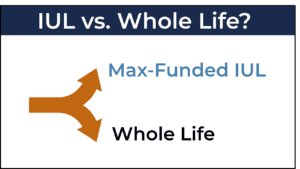 Say the words “permanent life insurance” and most people picture Whole Life. It has been around for well over a century, and for a long stretch it was the default pick for families who wanted lifelong coverage and a slow, steady buildup of cash value. But Whole Life is not the only option, and it is not always the best fit for someone who wants their policy to actually pull some weight in retirement.
In one of my recent shorts, I highlight why a properly structured, max-funded Indexed Universal Life policy (what I call an IUL LASER Fund) can outperform a traditional Whole Life policy over the long run. If you have ever wondered what the real difference is between these two, or why some families are quietly moving away from Whole Life, here it is in plain language.
What Whole Life Insurance Actually Does
Whole Life insurance is built to do two things: provide a death benefit that is in force for your entire life, and build a small pool of cash value inside the policy over time.
The insurance company decides how your cash value grows. It pools everyone’s premiums together, invests that money in conservative places like bonds, and credits you a modest amount of interest each year.
Some policies also pay dividends, but those dividends are not guaranteed. Growth can be steady but slow, and you generally have no say in how the money is invested.
Whole Life is considered to be typically stable and predictable, with real appeal for families who want a simple, hands-off policy with lifelong coverage.
But that stability comes with a trade-off. Growth potential inside the policy is usually limited, and much of the premium in the early years goes toward the cost of insurance rather than into your cash value.
What Indexed Universal Life Does Differently
IUL is also permanent life insurance, but the way the cash value grows is very different.
If you choose indexing strategies, instead of earning a small fixed rate set by the insurance company, your IUL cash value can earn interest based on the movement of a stock market index, such as the S&P 500. You are not actually invested in the market, so your money is not at risk of loss from a downturn.
The insurance company tracks the index and credits your policy based on how it performs, usually up to a certain cap.
Here is the key part: When the index goes up, you get credited a portion of that growth. When the index goes down, you are credited zero for that period, but you do not lose anything due to the market downturn.
And your previous gains are locked in. This is often called a “floor and ceiling” design. The floor protects you from losses. The ceiling limits how much you can earn in a great year.
Over long stretches of time, IUL’s indexing gives your policy the potential to generate more growth than the fixed crediting inside a traditional Whole Life policy, without exposing your money to market losses.
What “Max-Funded” Really Means
You might be wondering what we mean when we talk about “max-funded” IUL.
A max-funded IUL is a policy that is intentionally structured to put as much money as legally allowed into the cash value side of the policy, with the smallest death benefit the IRS will permit for that funding level. In other words, you buy just enough insurance to make the policy qualify as life insurance, and pour the rest into the growth engine.
Why do this?
Because the tax code gives life insurance some very favorable treatment. When a policy is properly structured and funded within IRS limits, the cash value can grow without being taxed each year, and you can access money via policy loans later triggering income taxes.
What’s more, the death benefit passes to your family income-tax-free.
How you fund the policy matters: If a policy is not max-funded, more of the money typically goes toward insurance costs rather than growth. If it is overfunded past the legal limit, it loses its tax advantages and becomes something called a Modified Endowment Contract (MEC), which the IRS treats very differently.
The sweet spot is right up against that max-funded line.
Why IUL Comes Out Ahead
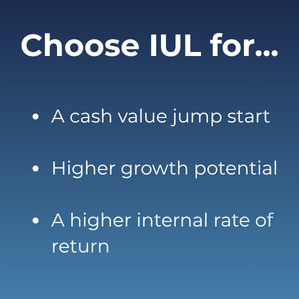
IUL can outperform Whole Life for a few reasons:
- Cash Value Jump Start – More of your IUL premium goes toward cash value from the start, rather than being eaten up by insurance costs.
- Higher Growth Potential – Your IUL’s growth potential is tied to market index performance, which historically has produced higher long-term returns than the conservative bond portfolios that back Whole Life policies.
- Higher Internal Rate of Return – IUL’s internal rate of return (IRR) tends to be higher than Whole Life. This means your fees and expenses are typically lower for IUL. But because Whole Life doesn’t disclose fees and expenses like IUL, the only way to see the difference is by seeing an IRR report comparing the two.
This doesn’t make IUL the right choice for everyone, but for families who want both protection and the opportunity for real long-term growth, it is worth considering IUL’s advantages.
A Few Honest Cautions
An IUL is not a magic wand. Results depend heavily on how the policy is designed, how it is funded, and how it is managed over time. A poorly structured IUL, or one that is not adequately funded, can underperform badly.
Caps and participation rates can change. And like any long-term financial vehicle, it works best when it is treated as a long-term commitment.
The Takeaway for Your Retirement
 Not all permanent life insurance is built the same. Whole Life and properly structured, max-funded IUL might look similar on the surface, but they behave very differently in terms of growth, flexibility, and how much of your money is actually working for you.
If retirement is on your mind, take the time to understand both options clearly, ask good questions, and make sure to turn to experts who can help you structure your policy for optimal performance.
Ready to Step Into a Brighter Future?
Start your IUL exploration today—access our free books, attend our educational webinars, or connect with a Certified Laser Fund Professional right here.
*Policy performance and/or experiences are shared for educational use only and do not predict or guarantee actual or future results.
_______________________
Watch Doug Andrew give a quick overview of these concepts on his YouTube channel…
Video Transcription
_______________________
Frequently Asked Questions (FAQs)
Q: Which permanent life insurance do you recommend — IUL or Whole Life?
A: We are proponents of properly structured, maximum-funded Indexed Universal Life, or IUL LASER Funds. Not only do they offer superior liquidity, protection from market downturns, and predictable rates of return, but they can also provide tax-free growth, access to tax-free cash via policy loans, and an income-tax-free transfer of wealth.
Q: Can I really access my IUL LASER Fund cash value tax-free?
A: Yes—when structured and accessed correctly, you can access your IUL LASER Fund’s cash value via policy loans, with no tax reporting under current law, supporting tax-free retirement income.
Q: Is there any risk of losing money due to market volatility in a LASER Fund?
A: The IUL LASER Fund strategy is built for safety—your principal is protected from market losses and credited interest can only go positive or zero, depending on market performance.
Q: What makes an IUL “properly structured” or “max-funded”?
A: A properly structured, max-funded IUL LASER Fund is optimized to minimize costs and maximize potential cash growth, staying within IRS guidelines to preserve tax advantages.
Q: Where can I learn more about the IUL LASER Fund or start my own policy?
A: Order our comprehensive “The LASER Fund” book for free (you just cover shipping) at laserfund.com, attend a virtual educational event, or connect with a certified expert by clicking here.
Still have questions? Want to unlock your own tax-free retirement strategy?
Connect with an IUL LASER Fund specialist today: Get started now.